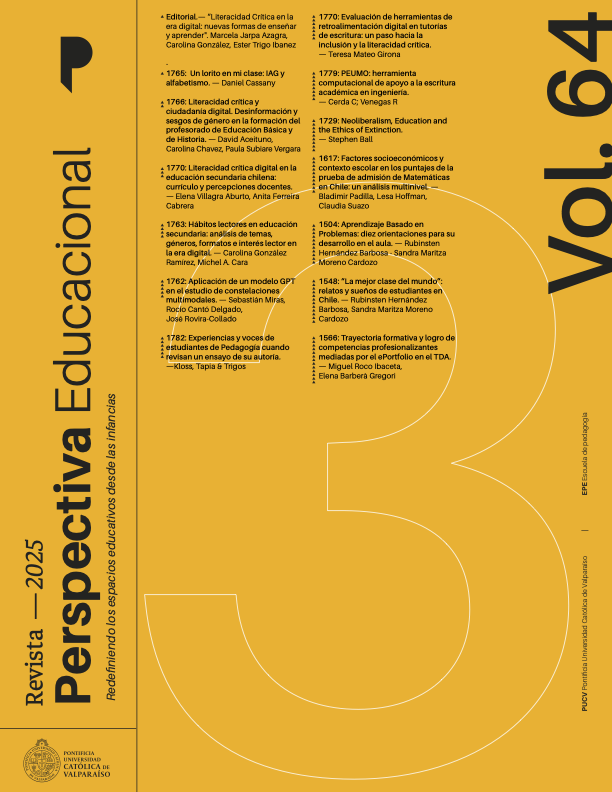
Neoliberalism, Education and the Ethics of Extinction
DOI:
https://doi.org/10.4151/07189729-Vol.64-Iss.3-Art.1729Palabras clave:
Curriculum Crisis ecológica Crecimiento económico Neoliberalismo Desarrollo sostenibleResumen
Este artículo aborda las complejas relaciones entre el neoliberalismo, la crisis climática y la educación. Se trata de una reflexión sobre la educación tal como es y sobre cómo podría ser de otro modo. Se sostiene que el neoliberalismo es, en muchos sentidos, “responsable” de la crisis climática y que, en tanto sistema ético, presagia nuestra extinción como especie. Asimismo, se afirma que la educación en su configuración actual —como escolarización— es cómplice del neoliberalismo en la producción de sujetos insostenibles. Frente a ello, el artículo esboza una educación “diferente”, que se sustenta en y reproduce una ética de continuidad de la vida y una subjetividad ecológica.
Citas
birdsswimming. (2009, March 8). David Harvey on accumulation by dispossession [Video]. YouTube. https://www.youtube.com/watch?v=3a9TAbQHzjQ
Ball, S. J. (2017). Foucault as Education. Palgrave. https://doi.org/10.1007/978-3-319-50302-8
Ball, S. J., & Collet-Sabé, J. (2025). Against School: Thinking education differently. Palgrave. https://doi.org/10.1007/978-3-031-80415-1
Barnosky, A. D., Hadly, E. A., & Smith, A. B. (2012). Approaching a State Shift in Earth's Biosphere. Nature, 486(7401), 52-58. https://doi.org/10.1038/nature11018
Bauman, Z. (2001). Modernity and Ambivalence. Polity Press.
Blake, J., Sterling, S., & Goodson, I. (2013). Transformative Learning for a Sustainable Future. Sustainability, 5(12), 5347-5372. https://doi.org/10.3390/su5125347
Blum, A. (2018, February 15). How the Enlightenment separated humanity from nature. Arc Digital. https://medium.com/arc-digital/how-the-enlightenment-separated-humanity-from-nature-c008881a61b0
Biesta, G. (2004). Against learning. Reclaiming a language for education in an age of learning. Nordisk Pedagogik, 24(1), 70–82. https://doi.org/10.18261/ISSN1891-5949-2004-01-06
Biesta, G. (2010). Good Education in an Age of Measurement. Paradigm Publishers.
Biesta, G. (2019). Should Teaching be Re(dis)covered? Introduction to a Symposium. Studies in Philosophy of Education, 38, 549-553. https://doi.org/10.1007/s11217-019-09667-y
Bollier, D., & Helfrich, S. (2020). Free, Fair and Alive. The insurgent power of the commons. New Society Publishers.
Boulding, K. (1966). The Economics of the Coming Spaceship Earth. In H. Jarrett (Ed.), Environmental Quality in a Growing Economy (pp. 3-14). Resources for the Future/Johns Hopkins University Press. https://arachnid.biosci.utexas.edu/courses/thoc/readings/boulding_spaceshipearth.pdf
Brown, W. (2018). Neoliberalism's Frankenstein: Authoritarian Freedom in Twenty-First Century “Democracies”. Critical Times, 1(1), 60-79. https://doi.org/10.1215/26410478-1.1.60
Bylund, L., Hellberg, S., & Knutsson, B. (2021). ‘We must urgently learn to live differently’: the biopolitics of ESD 2030. Environmental Education Research, 28(1), 40-55. https://doi.org/10.1080/13504622.2021.2002821
Chignola, S. (2019). Foucault's Politics of Philosophy. Power, Law, and Subjectivity. Routledge. https://doi.org/10.4324/9781315182094
Colmer, J. (2021, October 5). How does climate change shape inequality, poverty and economic opportunity. Economics Observatory. https://www.economicsobservatory.com/how-does-climate-change-shape-inequality-poverty-and-economic-opportunity
Dalmiya, V. (2002). Why Should a Knower Care? Hypatia, 17(1), 34-52. https://doi.org/10.1353/hyp.2002.0008
Foucault, M. (1992). The Use of Pleasure. The History of Sexuality: Volume Two. Penguin.
Foucault, M. (1997). The Ethics of the Concern of the Self as a Practice of Freedom. Ethics, Subjectivity and Truth. The New Press.
Fox, N., & Alldred, P. (2019). Sustainability, feminist posthumanism and the unusual capacities of (post) humans. Environmental Sociology, 6(2), 121-132. https://doi.org/10.1080/23251042.2019.1704480
Gienger, A., Nursey-Bray, M., Rodger, D., Szorenyi, A., Weinstein, P., Hanson-Easey, S., … Yoneyama, S. (2024). Responsible environmental education in the Anthropocene: understanding and responding to young people’s experiences of nature disconnection, eco-anxiety and ontological insecurity. Environmental Education Research, 30(9), 1619-1649. https://doi.org/10.1080/13504622.2024.2367022
Gillespie, S. (2020). Climate Crisis and Consciousness. Routledge. https://doi.org/10.4324/9780429346811
Haraway, D. (2003). The Companion Species Manifesto: Dogs, People and Significant Otherness. Prickly Paradigm Press.
Haraway, D. (2013). SF: Science fiction, speculative fabulation, string figures, so far. Ada: A Journal of Gender, New Media, and Technology, 3(1), 1-18.
Haraway, D. (2016). Staying with the Trouble: making kind in the chuthulucene. Duke University Press. https://doi.org/10.2307/j.ctv11cw25q
Hays, J., & Reinders, H. (2023). Discontinuity, Sustainability, and Critical Learnership: Development, Dynamics, and Demand. In E. Eleni Melitiadou (Ed.), Handbook of Research on Implications of Sustainable Development in Higher Education (pp. 115-143). IGI Global. https://doi.org/10.4018/978-1-6684-6172-3.ch006
Hickel, J. (2021). Less is More: How Degrowth Will Save the World. Windmill.
Hong, G. K. (2015). Death Beyond Disavowal: The Impossible Politics of Difference. Oxford University Press. https://doi.org/10.5749/minnesota/9780816695263.001.0001
Hopkins, H. (2020, June 8). Racism is killing the planet. Sierra (Sierra Club). https://www.sierraclub.org/sierra/racism-killing-planet
Jonas, H. (1984). The Imperative of Responsibility. In Search of an Ethics for the Technological Age. Chicago University Press. https://doi.org/10.7208/chicago/9780226850337.001.0001
Jorgenson, S. N., Stephens, J. C., & White, B. (2019). Environmental education in transition: A critical review of recent research on climate change and energy education. The Journal of Environmental Education, 50(3), 160-171. https://doi.org/10.1080/00958964.2019.1604478
Kahn, R. (2010). Critical pedagogy, ecoliteracy, & planetary crisis: The ecopedagogy movement. Peter Lang.
Komatsu, H., & Rappleye, J. (2017). A new global policy regime founded on invalid statistics? Comparative Education, 53(2), 166-191. https://doi.org/10.1080/03050068.2017.1300008
Komatsu, H., Silova, I., & Rappleye, J. (2023). Education and environmental sustainability: culture matters. Journal of International Cooperation in Education, 25(1), 108-123. https://doi.org/10.1108/JICE-04-2022-0006
Kopnina, H. (2020). Education for the future? Critical evaluation of education for sustainable development goals. The Journal of Environmental Education, 51(4), 280-291. https://doi.org/10.1080/00958964.2019.1710444
Lewis, T. E. (2012). Exopedagogy: On pirates, shorelines, and the educational commonwealth. Educational Philosophy and Theory, 44(8), 845-861. https://doi.org/10.1111/j.1469-5812.2011.00759.x
MacCormack, P. (2016). Posthuman Ethics. Routledge. https://doi.org/10.4324/9781315601670
Meadows, D. (2015). Thinking in systems. Chelsea Green Publishing.
Moghtader, B. (2016). Foucault and Educational Ethics. Palgrave Macmillan. https://doi.org/10.1007/978-1-137-57496-1
Mommers, J. (2020). How are we going to explain this? Profile Books.
Moore, J. (2016). Anthropocene or Capitalocene?: Nature, History, and the Crisis of Capitalism (Kairos). PM Press.
Norgaard, R. B. (2019). Economism and the Econocene: A coevolutionary interpretation. Real-World Economics Review, (87), 114-131. http://www.paecon.net/PAEReview/issue87/Norgaard87.pdf
Norgaard, R. B. (2021). Post-economics: Reconnecting reality and morality to escape the Econocene. Real-World Economics Review, (96), 49-66. https://www.paecon.net/PAEReview/issue96/Norgaard96.pdf
Olssen, M. (2009). Towards a global thin community: Nietzsche, Foucault and the cosmopolitan commitment. Paradigm.
Olssen, M. (2021). Constructing Foucault's Ethics. Manchester University Press. https://doi.org/10.7765/9781526156617
O’Neill, J. (2022, December 18). Carl Sagan’s keynote speech at the 5th Emerging Issues Forum (1990). Free Xenon. https://www.freexenon.com/2019/07/08/carl-sagans-keynote-speech-at-the-5th-emerging-issues-forum-1990/
Osberg, D. (2010). Taking Care of the Future? In D. Osberg, & G. Biesta (Eds.), Theory and the Politics of Education (pp. 157-170). Sense. https://doi.org/10.1163/9789460912405
Peck, J., & Theodore, N. (2019). Still Neoliberalism? South Atlantic Quarterly, 118(2), 245-265. https://doi.org/10.1215/00382876-7381122
Plumwood, V. (1993). Feminism and the Mastery of Nature. Routledge.
Sauvé, L. (2005). Currents in environmental education: Mapping a complex and evolving pedagogical field. Canadian Journal of Environmental Education, 10, 11-37. https://files.eric.ed.gov/fulltext/EJ881772.pdf
Sicilia-Camacho, A., & Fernández-Balboa, J. M. (2009). Reflecting on the moral bases of critical pedagogy in PETE: towards a Foucauldian perspective on ethics and the care of the self. Sport, Education and Society, 14(4), 443-463. https://doi.org/10.1080/13573320903217166
Silova, I., Komatsu, H., & Rappleye, J. (2018, Octubre 12). Facing the climate change catastrophe: Education as solution or cause? NORRAG. https://www.norrageducation.org/facing-the-climate-change-catastrophe-education-as-solution-or-cause-by-iveta-silova-hikaru-komatsu-and-jeremy-rappleye/
Stanescu, J. (2013). Beyond Biopolitics: Animal Studies, Factory Farms, and the Advent of Deading Life. PhaenEx, 8(2), 135-160. https://doi.org/10.22329/p.v8i2.4090
Straume, I. S. (2019). What may we hope for? Education in times of climate change. Constellations, 27, 540-552. https://doi.org/10.1111/1467-8675.12445
Tannock, S. (2020). The oil industry in our schools: from Petro Pete to science capital in the age of climate crisis. Environmental Education Research, 26(4), 474-490. https://doi.org/10.1080/13504622.2020.1724891
Varpanen, J., Kallio, J., Saari, A., Helkala, S., & Holmberg, L. (2024). Attunements of Care – The Art of Existence in the Anthropocene. Research in Arts and Education, 2, 53-63. https://doi.org/10.54916/rae.141907
Warren, J. K. (2000). Ecofeminist Philosophy: A Western Perspective on What It Is and Why It Matters. Rowman & Littlefield.
Whyte, K. P., & Cuomo, C. (2017). Ethics of Caring in Environmental Ethics: Indigenous and Feminist Philosophies. In S. M. Gardiner, & A. Thompson (Eds.), The Oxford Handbook of Environmental Ethics (pp. 234-247). Oxford University Press. https://doi.org/10.1093/oxfordhb/9780199941339.013.22
Willamo, R. (2005). Kokonaisvaltainen lähestymistapa ympäristönsuojelutieteessä: Sisällön moniulot- teisuus ympäristönsuojelijan haasteena. (Environmentalica Fennica 23). Helsingin yliopisto. https://helda.helsinki.fi/bitstream/handle/10138/22238/kokonais.pdf?se- quence=1&isAllowed=y
Wolf, L.-A. (2014). Nature and sustainability: An educational study with Rousseau and Foucault. Abo Akademi. https://doi.org/10.1080/13504622.2013.833587
World Meteorological Organization. (2024, November 11). State of the climate 2024: Update for COP29. WMO. https://wmo.int/publication-series/state-of-climate-2024-update-cop29
Descargas
Publicado
Cómo citar
Número
Sección
Licencia
Derechos de autor 2025 Stephen Ball

Esta obra está bajo una licencia internacional Creative Commons Atribución-CompartirIgual 4.0.
El/los autores/as otorgan licencia exclusiva y sin límite de temporalidad para que el manuscrito sea publicado en la revista Perspectiva Educacional, editada por la Pontificia Universidad Católica de Valparaíso (Chile), a través de la Escuela de Pedagogía.