Comparison of educational and learning capitals in students with and without high intellectual ability from the Actiotope Model of Giftedness
DOI:
https://doi.org/10.4151/07189729-Vol.65-Iss.1-Art.1821Keywords:
Actiotope Model of Giftedness educational and learning capitals QELC comparison normative population MexicanAbstract
The ACTIOTOPE model of giftedness is based on the idea that giftedness is not an inherent trait, but rather the result of successful adaptations to environmental determinants. It introduces the concepts of educational and learning capital, which are fundamental resources that facilitate excellence. The Questionnaire on Educational and Learning Capital (QELC) provides an understanding of the resources that contribute to academic and professional success. It has been validated in several countries, demonstrating its cross-cultural applicability. For example, in Mexico, the results showed that the original factor structure presents an absolute fit and low levels of error. Research has shown that educational and learning capital are important predictors of academic performance, highlighting the importance of environmental and personal resources in fostering academic excellence.
The QELC consists of subscales that measure the five forms of educational capital (economic, cultural, social, infrastructural, and didactic) and the five forms of learning capital (organismic, actional, telic, episodic, and attentional). It is not only a research tool, but also a practical instrument for educators, helping to identify students who could benefit from additional resources or support, enabling educators to create personalized learning environments that foster excellence. The objective of this study was to compare the Educational and Learning Capitals of students with high intellectual ability and those without high intellectual ability in the fourth, fifth, and sixth grades of primary school and the first through third grades of secondary school. The study was descriptive and cross-sectional. A total of 354 students participated, including those with high intellectual ability (N = 178) and those without high ability (N = 176), all from public schools. A Student's t-test for independent samples was performed, and the effect size was calculated. The results indicate significant differences in educational and learning capital. In relation to the educational capital subscales, differences were found in the economic, cultural, social, infrastructure, and didactic subscales, where students with high ability obtained higher scores than students without high ability. The effect size is large in educational, economic, and infrastructure capital and medium for the rest of the educational capitals. On the other hand, with regard to Learning Capital, significant differences were found in this and in Organic, Actional, Episodic, and Attentional Capital, where students with high abilities obtained higher scores. A high effect size was observed in Organic Capital, and a medium effect size in Learning, Actional, Episodic, and Attention Capital. Only in Telic Capital were no differences observed. The findings confirm the relevance of the ACTIOTOPE Model as a guiding framework for the comprehensive care of gifted students, offering clear guidelines for coordinated intervention in the academic, social, and family spheres, avoiding fragmented approaches and favoring a systemic view of development. In particular, the data highlight the need for dynamic interaction between both types of capital, which drives excellence and positive adaptation among students.
References
Al-Hroub, A. (2023). Evaluación de la educación para superdotados en Palestina: Un estudio de los capitales educativos y de aprendizaje. Cogent Education, 10(2), Art. 2240931. https://doi.org/10.1080/2331186X.2023.2240931
Bronfenbrenner, U. (1979). The ecology of human development: Experiments in nature and design. Harvard University Press. https://doi.org/10.2307/j.ctv26071r6
Csikszentmihalyi, M., Rathunde, K., & Whalen, S. (1993). Gifted adolescents: the roots of success and failure. Cambridge University Press.
Dweck, C. S. (2006). Mindset: the new psychology of success. Random House.
Ericsson, A., & Pool, R. (2016). Peak: Secrets from the new science of expertise. Houghton Mifflin Harcourt.
Gagné, F. (2004). Transforming gifts into talents: The DMGT as a developmental theory. High Ability Studies, 15(2), 119-147. https://doi.org/10.1080/1359813042000314682
Gagné, F. (2021). Differentiated model of giftedness and talent (DMGT 2.0). In S. Pfeiffer (Ed.), APA handbook of giftedness and talent (pp. 195-215). American Psychological Association.
Hafsyan, A. S. (2023). Gifted education in the State of Kuwait: Review from a learning-resource perspective. Cogent Education, 10, Art. 2224518. https://doi.org/10.1080/2331186X.2023.2224518
Hemdan, A. H., Ambusaidi, A., & Al-Kharusi, T. (2022). Educación para superdotados en Omán: Análisis desde una perspectiva de recursos de aprendizaje. Cogent Education, 9(1), Art. 2064410. https://doi.org/10.1080/2331186X.2022.2064410
Monks, F. J. (1996). Herencia y ambiente: Una aproximación interactiva hacia el talento. Revista de Psicología de la PUCP, 14(2), 111-128. https://doi.org/10.18800/psico.199602.001
Neihart, M., Pfeiffer, S. I., & Cross, T. L. (2016). The social and emotional development of gifted children: What do we know? (2nd ed.). Prufrock Press.
Novak, A. M. (2023). Income, inequity, and intersectionality: Reaching students that are gifted and talented and living in poverty. EdArXiv. https://doi.org/10.35542/osf.io/3ckua
Ortiz, G. E., Valadez, M. D., Betancourt, J., Borges, Á., & López, G. (2025). Analysis of educational and learning capital for the attention of students with high abilities in Mexico. Cogent Education, 12(1), Art. 2442887. https://doi.org/10.1080/2331186x.2024.2442887
Ortiz, G. E., Valadez, M. D., Rivera, M., Vargas, M. L., Reynoso, O. U., & Fuentes-Balderrama, J. M. (2021). Validation of the educational and learning capital questionnaire (QELC). Psychological Test and Assessment Modeling, 63, 227-238.
Pérez Barrera, S. G., & Arbelo-Marrero, L. Y. (2024). Gifted education in Uruguay: analyses from a learning-resource perspective. Cogent Education, 11(1), Art. 2422741. https://doi.org/10.1080/2331186x.2024.2422741
Renzulli, J. S. (2012). Reassessing the role of gifted education and talent development in the 21st century: A four-part theoretical approach. Gifted Child Quarterly, 56(3), 150-159. https://doi.org/10.1177/0016986212444901
Stöger, H., & Ziegler, A. (2008). Evaluation of a classroom training program to improve self-regulation in time management tasks during homework activities with fourth-grade students. Metacognition and Learning, 3(3), 207-230. https://doi.org/10.1007/s11409-008-9027-z
Subotnik, R. F., Olszewski-Kubilius, P., & Worrell, F. C. (2011). Rethinking giftedness and gifted education: A proposed direction forward based on psychological science. Psychological Science in the Public Interest, 12(1), 3-54. https://doi.org/10.1177/1529100611418056
The Jamovi Project. (2021). Jamovi (versión 1.6) [Computer Software]. https://www.jamovi.org
Vladut, A., Leana-Taşcılar, M., Vialle, W., & Ziegler, A. (2013). A cross-cultural validation study of the questionnaire of educational and learning capital (QELC) in China, Germany and Turkey. Psychological Test and Assessment Modeling, 55(4), 462-478. https://hdl.handle.net/10779/uow.27708501.v1
Vladut, A., Vialle, W., & Ziegler, A. (2015). Learning resources within the Actiotope: A validation study of the QELC (Questionnaire of Educational and Learning Capital). Psychological Test and Assessment Modeling, 57(1), 40-56. https://psycnet.apa.org/record/2015-31974-003
Vuyk, M. A., Montania, M., Barrios, L., & Lobo, M. (2024). Gifted education in Paraguay: analyses from a learning-resource perspective. Cogent Education, 11(1), Art. 2332863. https://doi.org/10.1080/2331186x.2024.2332863
Ziegler, A. (2012). Generalizing realizability and Heyting models for constructive set theory. Annals of Pure and Applied Logic, 163(2), 175-184. https://doi.org/10.1016/j.apal.2011.06.025
Ziegler, A., Chandler, K. L., Vialle, W., & Stöger, H. (2017). Exogenous and endogenous learning resources in the actiotope model of giftedness and their importance for gifted education. Journal for the Education of the Gifted, 40(4), 310-333. https://doi.org/10.1177/0162353217734376
Ziegler, A., Debatin, T., & Stöger, H. (2019). Learning resources and talent development from a systems perspective. Annals of the New York Academy of Sciences, 1445(1), 39-51. https://doi.org/10.1111/NYAS.14018
Ziegler, A. & Stöger, H. (2008). A learning oriented subjective action space as an indicator of giftedness. Psychology Science Quarterly, 50(2), 222-236.
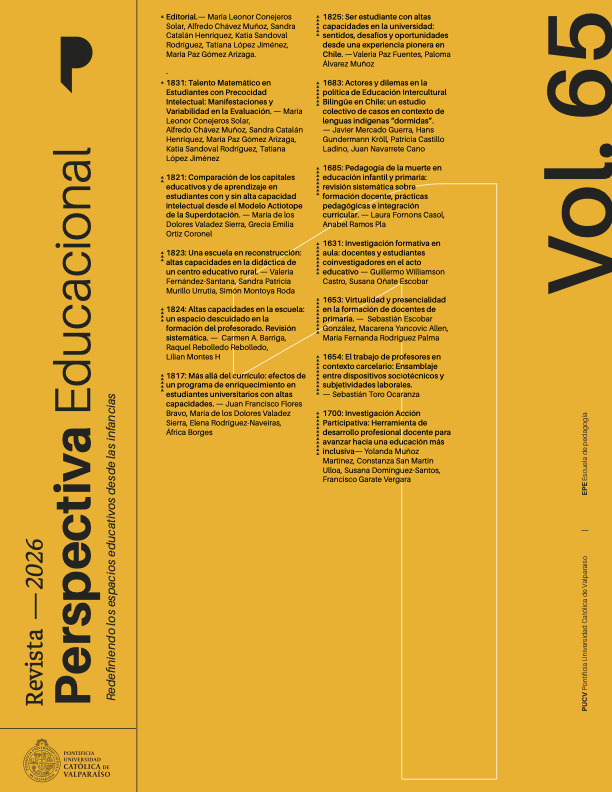
Downloads
Published
How to Cite
Issue
Section
License
Copyright (c) 2026 María de los Dolores Valadez Sierra, Grecia Emilia Ortiz Coronel

This work is licensed under a Creative Commons Attribution-ShareAlike 4.0 International License.
The authors grant an exclusive licence, without time limit, for the manuscript to be published in the Perspectiva Educacional journal, published by the Pontificia Universidad Católica of Valparaíso (Chile), through the School of Pedagogy.