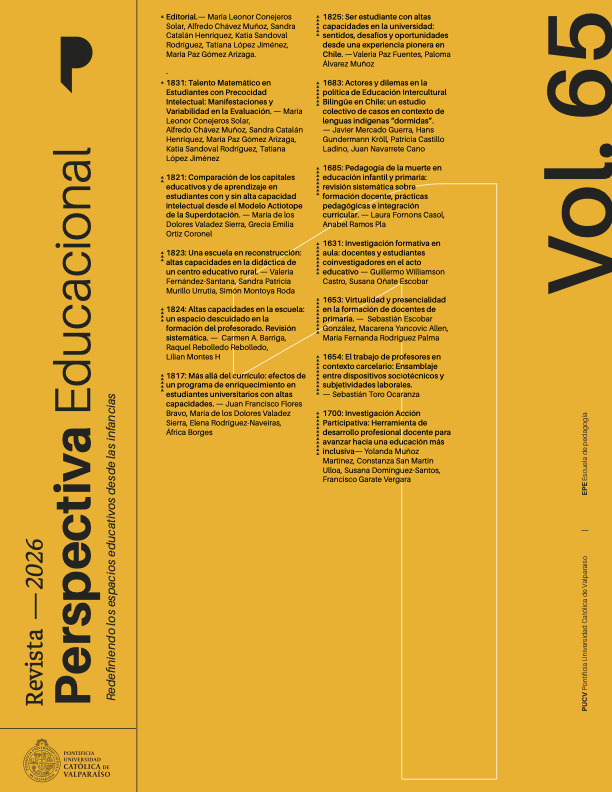
Comparación de los capitales educativos y de aprendizaje en estudiantes con y sin alta capacidad intelectual desde el Modelo Actiotope de la Superdotación
DOI:
https://doi.org/10.4151/07189729-Vol.65-Iss.1-Art.1821Palabras clave:
Actiotope Model of Giftedness capitales educativos y de aprendizaje QELC comparación población normativa mexicanaResumen
El Actiotope Model of Giftedness concibe el talento como resultado de adaptaciones exitosas entre el individuo y su entorno, destacando el papel de los capitales educativos y de aprendizaje. El Cuestionario QELC-Mx permite evaluar estos recursos, y su validación en México confirma su validez estructural y utilidad diagnóstica. Este estudio comparó los capitales en 354 estudiantes de Educación Básica con (n = 178) y sin (n = 176) alta capacidad intelectual, elegidos por conveniencia. Los alumnos con altas capacidades pertenecen a una escuela de agrupamiento total, mediante un diseño descriptivo transversal. Los resultados revelaron diferencias significativas a favor del grupo con alta capacidad en casi todas las subescalas, con tamaños de efecto grandes en los capitales educativo, económico, de infraestructura y orgánico. Solo el capital télico no mostró diferencias. Estos hallazgos respaldan la pertinencia del Actiotope Model como marco teórico integral para orientar intervenciones educativas, destacando la importancia de una articulación dinámica entre recursos personales y contextuales que potencie trayectorias de excelencia académica.
Citas
Al-Hroub, A. (2023). Evaluación de la educación para superdotados en Palestina: Un estudio de los capitales educativos y de aprendizaje. Cogent Education, 10(2), Art. 2240931. https://doi.org/10.1080/2331186X.2023.2240931
Bronfenbrenner, U. (1979). The ecology of human development: Experiments in nature and design. Harvard University Press. https://doi.org/10.2307/j.ctv26071r6
Csikszentmihalyi, M., Rathunde, K., & Whalen, S. (1993). Gifted adolescents: the roots of success and failure. Cambridge University Press.
Dweck, C. S. (2006). Mindset: the new psychology of success. Random House.
Ericsson, A., & Pool, R. (2016). Peak: Secrets from the new science of expertise. Houghton Mifflin Harcourt.
Gagné, F. (2004). Transforming gifts into talents: The DMGT as a developmental theory. High Ability Studies, 15(2), 119-147. https://doi.org/10.1080/1359813042000314682
Gagné, F. (2021). Differentiated model of giftedness and talent (DMGT 2.0). In S. Pfeiffer (Ed.), APA handbook of giftedness and talent (pp. 195-215). American Psychological Association.
Hafsyan, A. S. (2023). Gifted education in the State of Kuwait: Review from a learning-resource perspective. Cogent Education, 10, Art. 2224518. https://doi.org/10.1080/2331186X.2023.2224518
Hemdan, A. H., Ambusaidi, A., & Al-Kharusi, T. (2022). Educación para superdotados en Omán: Análisis desde una perspectiva de recursos de aprendizaje. Cogent Education, 9(1), Art. 2064410. https://doi.org/10.1080/2331186X.2022.2064410
Monks, F. J. (1996). Herencia y ambiente: Una aproximación interactiva hacia el talento. Revista de Psicología de la PUCP, 14(2), 111-128. https://doi.org/10.18800/psico.199602.001
Neihart, M., Pfeiffer, S. I., & Cross, T. L. (2016). The social and emotional development of gifted children: What do we know? (2nd ed.). Prufrock Press.
Novak, A. M. (2023). Income, inequity, and intersectionality: Reaching students that are gifted and talented and living in poverty. EdArXiv. https://doi.org/10.35542/osf.io/3ckua
Ortiz, G. E., Valadez, M. D., Betancourt, J., Borges, Á., & López, G. (2025). Analysis of educational and learning capital for the attention of students with high abilities in Mexico. Cogent Education, 12(1), Art. 2442887. https://doi.org/10.1080/2331186x.2024.2442887
Ortiz, G. E., Valadez, M. D., Rivera, M., Vargas, M. L., Reynoso, O. U., & Fuentes-Balderrama, J. M. (2021). Validation of the educational and learning capital questionnaire (QELC). Psychological Test and Assessment Modeling, 63, 227-238.
Pérez Barrera, S. G., & Arbelo-Marrero, L. Y. (2024). Gifted education in Uruguay: analyses from a learning-resource perspective. Cogent Education, 11(1), Art. 2422741. https://doi.org/10.1080/2331186x.2024.2422741
Renzulli, J. S. (2012). Reassessing the role of gifted education and talent development in the 21st century: A four-part theoretical approach. Gifted Child Quarterly, 56(3), 150-159. https://doi.org/10.1177/0016986212444901
Stöger, H., & Ziegler, A. (2008). Evaluation of a classroom training program to improve self-regulation in time management tasks during homework activities with fourth-grade students. Metacognition and Learning, 3(3), 207-230. https://doi.org/10.1007/s11409-008-9027-z
Subotnik, R. F., Olszewski-Kubilius, P., & Worrell, F. C. (2011). Rethinking giftedness and gifted education: A proposed direction forward based on psychological science. Psychological Science in the Public Interest, 12(1), 3-54. https://doi.org/10.1177/1529100611418056
The Jamovi Project. (2021). Jamovi (versión 1.6) [Computer Software]. https://www.jamovi.org
Vladut, A., Leana-Taşcılar, M., Vialle, W., & Ziegler, A. (2013). A cross-cultural validation study of the questionnaire of educational and learning capital (QELC) in China, Germany and Turkey. Psychological Test and Assessment Modeling, 55(4), 462-478. https://hdl.handle.net/10779/uow.27708501.v1
Vladut, A., Vialle, W., & Ziegler, A. (2015). Learning resources within the Actiotope: A validation study of the QELC (Questionnaire of Educational and Learning Capital). Psychological Test and Assessment Modeling, 57(1), 40-56. https://psycnet.apa.org/record/2015-31974-003
Vuyk, M. A., Montania, M., Barrios, L., & Lobo, M. (2024). Gifted education in Paraguay: analyses from a learning-resource perspective. Cogent Education, 11(1), Art. 2332863. https://doi.org/10.1080/2331186x.2024.2332863
Ziegler, A. (2012). Generalizing realizability and Heyting models for constructive set theory. Annals of Pure and Applied Logic, 163(2), 175-184. https://doi.org/10.1016/j.apal.2011.06.025
Ziegler, A., Chandler, K. L., Vialle, W., & Stöger, H. (2017). Exogenous and endogenous learning resources in the actiotope model of giftedness and their importance for gifted education. Journal for the Education of the Gifted, 40(4), 310-333. https://doi.org/10.1177/0162353217734376
Ziegler, A., Debatin, T., & Stöger, H. (2019). Learning resources and talent development from a systems perspective. Annals of the New York Academy of Sciences, 1445(1), 39-51. https://doi.org/10.1111/NYAS.14018
Ziegler, A. & Stöger, H. (2008). A learning oriented subjective action space as an indicator of giftedness. Psychology Science Quarterly, 50(2), 222-236.
Descargas
Publicado
Cómo citar
Número
Sección
Licencia
Derechos de autor 2026 María de los Dolores Valadez Sierra, Grecia Emilia Ortiz Coronel

Esta obra está bajo una licencia internacional Creative Commons Atribución-CompartirIgual 4.0.
El/los autores/as otorgan licencia exclusiva y sin límite de temporalidad para que el manuscrito sea publicado en la revista Perspectiva Educacional, editada por la Pontificia Universidad Católica de Valparaíso (Chile), a través de la Escuela de Pedagogía.